STRIKING IT RICH: Rugby's defence gurus are becoming like bowlers in the IPL


JACQUES ISN’T THE ONLY DEFENCE COACH UNDER THREAT
Some of them may earn enough money to live on luxurious golfing estates, but that doesn’t mean we should envy those who have the job description of rugby defence coach right now. They are under threat with two of the best in the trade in the headlines for the wrong reasons this week.
Jacques Nienaber, the man who built the formidable defensive system that remains the foundation of the Springbok game, has become so sick of being scapegoated for Leinster’s failure to add to the four stars on their chest that signify the Irish province’s number of Investec Champions Cup titles that he left nothing unsaid in a press conference.
Advertisement
Then there is seven-time Six Nations title winner, four times with Wales and three times with France, Shaun Edwards, who is arguably the most fabled defence coach in the game. The former Wigan rugby league legend and coach of an all-conquering Wasps team a few decades back is being sacked by France coach Fabien Galthie in a move that has surprised several pundits, among them former England and British and Irish Lions lock Simon Shaw.
“Recent speculation that France could be willing to let Edwards leave has been surprising, and in many ways shortsighted,” said Shaw in a LinkedIn post that was picked up by the RugbyPass website.
“Coaches of his calibre are exceptionally rare,” he added before going on to say that Edwards had been “a central figure to France’s rise to the top of the international game”.
The same could be said about Edwards’ impact at Wales under Warren Gatland and he was central to the Lions being competitive too, and you wouldn’t have to search too hard to find a former Springbok or Stormers player who’d say similar things about Nienaber.
IT IS THE FAULT OF EVOLUTION
So why is rugby starting to resemble, at least when it comes to scoring, the early era of the Super 12 when UK critics slammed it for being too much like the “you score and then we score” narrative that basketball seems to present? Well, rugby is a constantly evolving sport and the two coaches may be the victims, in Edwards’ case his head coach and in Nienaber’s case former players now working as pundits, of an over-simplistic view that is blind to the change that has rendered defences less of the dominant factor they used to be.
That’s not to say that defence isn’t still important, just that it may be folly to judge the effectiveness of the defence coach on what is seen in the tries-against column. It isn’t demonstrated by the low scores of previous eras. Nienaber was very much the most influential voice at the Stormers in the year that they topped the Super Rugby log most of the way in a 2012 season where the Cape team won most of their games but were criticised for not managing to get try-scoring bonus points.
I remember in that season counting the tries scored against the Stormers, and for much of the way, there were as many games played as tries scored. There have been several World Cup-winning efforts built around defence, and Nienaber has featured there twice, while Australian John Muggleton, who, like Edwards, had come from rugby league, presided over a Wallabies defensive system that conceded just two tries in their entire successful 1999 World Cup campaign.
Four years later it was the English forwards and Jonny Wilkinson who got the plaudits, but defence coach Phil Larder was also highly influential in that nation’s only World Cup triumph.
But the rugby decision makers have been constantly trying to change the balance, to thrust attack and try scoring more to the fore, and if you look at the high scoring games we are witnessing at all levels, they are succeeding. The 50 points France conceded against Scotland at Murrayfield in the most recent Six Nations and then the more than 40 conceded to England at home later in the tournament would have irked Galthie even though his team won the competition.
There are reasons, such as lack of relegation, other than poor defence, that Gallagher Premiership games have this season seen some ridiculous high scores, but it was a game between two English sides that was not in the Premiership but in the Champions Cup that I most remember. Bath won their home quarterfinal 43-41.
The Pool games in that competition saw some high scoring, with the two games the Vodacom Bulls lost in Pretoria being cases in point - they started out losing 46-31 to a Bordeaux-Begles team that admitted afterwards that they’d built their focus around the expectation of a high-scoring game, and then Bristol Bears learned off them, winning 61-49.
A big part of the change was explained by Bok assistant coach Felix Jones at a press conference earlier in the year. Put simply, the contestable kicking aspect of rugby has become all-important, and players are now being coached on where to stand so they can attack with the ball that is tapped back. Yes, the aim isn’t to catch, it just needs to be tapped back. And that is obviously very difficult to defend against.
Is it good for the game? Well, that aforementioned Bath/Northampton game was spellbinding, but if you asked the English scribes who attacked the Super 12 back in the 1990s, they would surely be obligated to say no.
I would equate it to what is happening in limited overs cricket through the T20 flagship, the IPL. There have been some obscene scores, and the accumulation of sixes has got to the point where clearing the boundary has become mundane.
There’s a tipping point where the balance becomes too lopsided, and while we are not there yet in rugby, the sport should be wary of reaching that point. In the meantime, defence coaches are just going to have to accept the same lot as bowlers in the IPL. You’re being measured by a different metric from what used to be the case.
SACHA’S INJURY A REMINDER OF WHY PLAYERS EARN THE BIG BUCKS
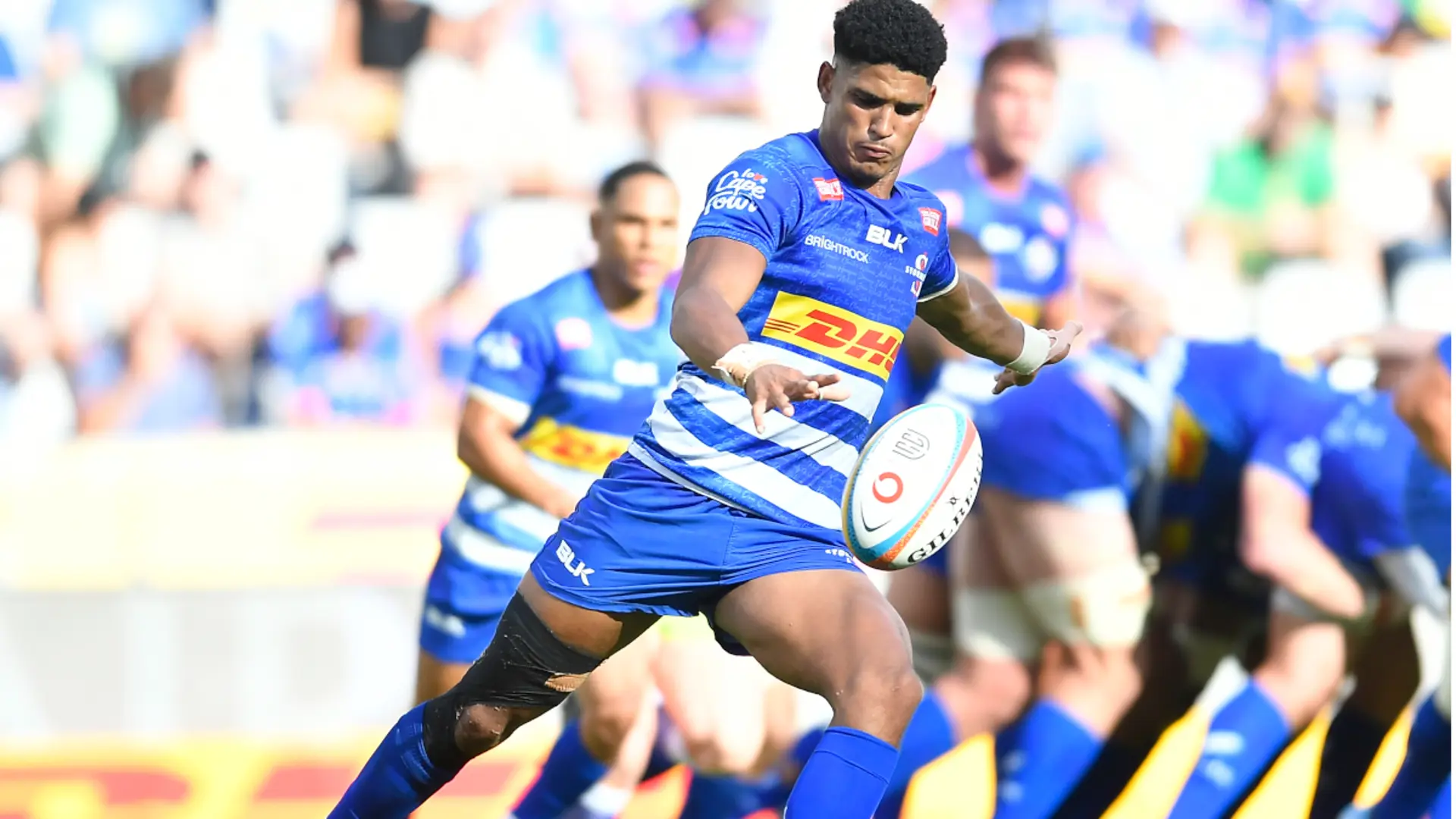
Here’s an admission - when Sacha Feinberg-Mngomezulu lay prone behind the Cardiff tryline before limping to the sidelines in last weekend’s Vodacom URC quarterfinal at the DHL Stadium, it felt like I was watching a premonition come true.
For weeks, there’d been this nagging feeling that something might happen to rob the Stormers of their star player in the business end of the competition. As the international season has approached, the possibility of the Springboks being without him against England and beyond that into the Greatest Rivalry Series also started to nag.
Now, before you make the mistake of assuming I am making a claim for having some kind of special sixth sense, that is far from the case. It is more just recognition of the physical nature of rugby and the attrition rate in the sport. The more you play, the more chance there is of injury, and one of the many reasons I’d hate to be a professional rugby player is because you’re always just one step, one poor challenge from an opponent or one freaky mistimed placement of your foot, away from having your immediate outlook, your season or, in the worst case scenarios, you entire career completely changed.
And sometimes it doesn’t have to be a career-ending injury that brings big change; it can be an injury that robs you of whatever it was that made you special. I still have a vivid memory of the beaming smile Bob Skinstad wore to the Newlands post-match press conference after he led the Stormers to a very comprehensive and stylish win over the Crusaders in 1999.
It was the famous ‘Men in Black’ season, Skinstad was in his pomp, and his Stormers teammates were thriving off his leadership and his undeniable class. They played in different positions, but Skinstad was the Sacha of that era - he had time on the ball, he had a skill set unmatched by his peers, and he at times made those around him look like they were playing the game in slow motion.
Skinstad and the Stormers were at the top of their game and that win over the Crusaders, who were the reigning Super 12 champions, established the Stormers as clear favourites to go on and replace them as title holders.
But it didn’t turn out that way; that press conference was the last time we saw that Skinstad beaming smile for quite a while, and that game was the last time anyone saw the version of Bob Skinstad as a player that had been presented during that Super 12 and the latter part of the previous season.
Yes, he did come back from the knee injury he sustained later that night in a car accident; he even went on later to captain South Africa, but he was never again quite the explosive player he had been.
Of course, Bob’s story was not unique. Remember Jaco Taute? An explosive attacking player when he played fullback for the Lions, Taute did well to return to the game after rupturing his knee when on loan to the Stormers in 2013 and have a successful career overseas. But he survived in the sport by reinventing himself and he lost the point of difference with other players that was the foundation of his promise.
And if you watched the legendary Chester Williams in the last years of his career, you would have seen a canny, smart player who relied on positional sense to be in the right place at the right time, but he was no longer the attacking force he had been before snapping his ACL on his right knee in 1996 and then doing the same to his left knee in 1997.
One injury. That’s all it takes. And that is always the argument I have for people who complain about the money modern players earn. The first point of the counter-argument to those people is always the length of a player’s career - it is usually, at best, not much more than a decade. And the second is what fate can deal you, as for many, the time at the top level of the game is cut short before they get close to a decade in the game.
IN THIS CASE, THE INJURY MIGHT EVEN BE BENEFICIAL
Thankfully, Sacha, and I will refer to him just by his first name for the same reason we used to do it with Naas, never suffered a career-ending or career-changing injury in the game against Cardiff. He will be back after three months, and the break he will take now, after almost 14 months of constant playing and being in the spotlight, may even be good for him. It is a chance to reflect and then reset, which may be beneficial both to him and the teams he plays for.
As set out in the SuperSport.com Talking Point earlier this week, it isn’t as if the Springboks have never won without Sacha. The same for the Stormers, with John Dobson’s management of his back-up, Jurie Matthee, being vindicated by the important task he will take on his shoulders in Dublin on Saturday.
Losing the competition’s best flyhalf does rob the semifinal of some of its box office quality, and the same can be said of the first test matches of the new international season. Which was why I was getting incrementally more nervous every time Sacha took the field that something like what happened this past weekend might happen.
But you can’t wrap a player in cotton wool, and the threat of injury comes with the territory for a top player. In fact, any player. I’d also hesitate to agree with those, and this may include the player himself, judging from his social media posts, who say he has been unlucky. Yes, it is unlucky to sustain an injury in the way he did, but given how physical he is, he did well to get through 14 months relatively uninterrupted.
There were a few minor injuries that kept him out of rugby for the odd game, but he’s had a fair run in comparison with his previous seasons since graduating to top-level senior rugby, where he often spent more time off the field in rehabilitation than on it.
THE STORMERS PENALTY THAT HELPED THE BULLS
The penalty that Feinberg-Mngomezulu kicked to earn the Stormers a losing bonus point against Cardiff in their final URC league game may turn out to have helped the Bulls more than it did themselves. It was that kick that separated the Stormers from the Bulls on the final log, effectively clinching third place ahead of the Pretoria team’s fourth.
Had the nine-point Cardiff advantage been retained, and the kick was the last move of the game, the two South African teams would have ended on the same number of points, and it would have been a very close count-out in the points differential column to determine the finishing order.
On the face of it, you’d say it doesn’t matter if you end third or fourth, but it could matter in a big way if both the local teams win their away semi-finals. Third playing fourth would mean the Stormers host a home final on 20 June, and we don’t need to go into the financial benefits of hosting the deciding game.
But it is largely because of the way the draw has worked out that the Bulls are rightly being considered more likely finalists this year than the Stormers. It is not about which is the better team, but because going to Leinster is considered a much bigger hurdle to overcome than going to Glasgow. And that is particularly so now that Glasgow aren’t hosting their semi in Glasgow, but at Murrayfield in Edinburgh. Meaning away from the Scotstoun 4G pitch.
My money says it will be a Leinster/Bulls final, in other words, a repeat of last year’s decider in Dublin, only with the visiting team having more time to acclimatise because of the fortnight gap between the semifinal round and the final.
CAPE TOWN FINAL WOULD SCUPPER MY TRIP TO GQEBERHA
This column was initially built around my travelling for rugby, or watching rugby while travelling, so I look forward to taking it back to its roots at the earliest opportunity. That first opportunity will be the Springbok versus Barbarians game in Gqeberha on 20 June - provided that the Stormers and Bulls don’t win their semis and set up a Cape Town final for that day.
Obviously, going to a DHL Stadium final will be first prize because of the magnitude of the occasion. The venue will be packed to the rafters if it is a north/south derby in a manner which Covid prevented it from being in the inaugural final between the two teams back in 2022. The attendance for that game was set at a 30 000 limit.
But it would be a bit frustrating to be forced to make a choice that weekend. I completely understand why the URC have scheduled a fortnight gap between the semifinal and probably argued for that this time last year. Giving away teams time to get to the city where the game will be played in a cross-hemisphere competition should improve the quality of the competition’s showpiece game.
But having the Boks and SA A playing on the same day as the franchise bread and butter competition is decided does seem a bit crazy to me and from a completely selfish perspective I’d prefer it if I could do both - head to DHL Stadium next week for a final and then to Gqeberha a week later for the first international game of the new season and a chance to write about the journey...
Advertisement