STRIKING IT RICH: Dale Steyn was right, Rabada should be thanked for his blip


There’s not much happening in local rugby, with the Guinness Six Nations the only point of interest until next week the Sharks go to Johannesburg for their Vodacom URC derby against the Lions and then the following week it is the Lions hosting the Stormers and the Sharks are in Pretoria.

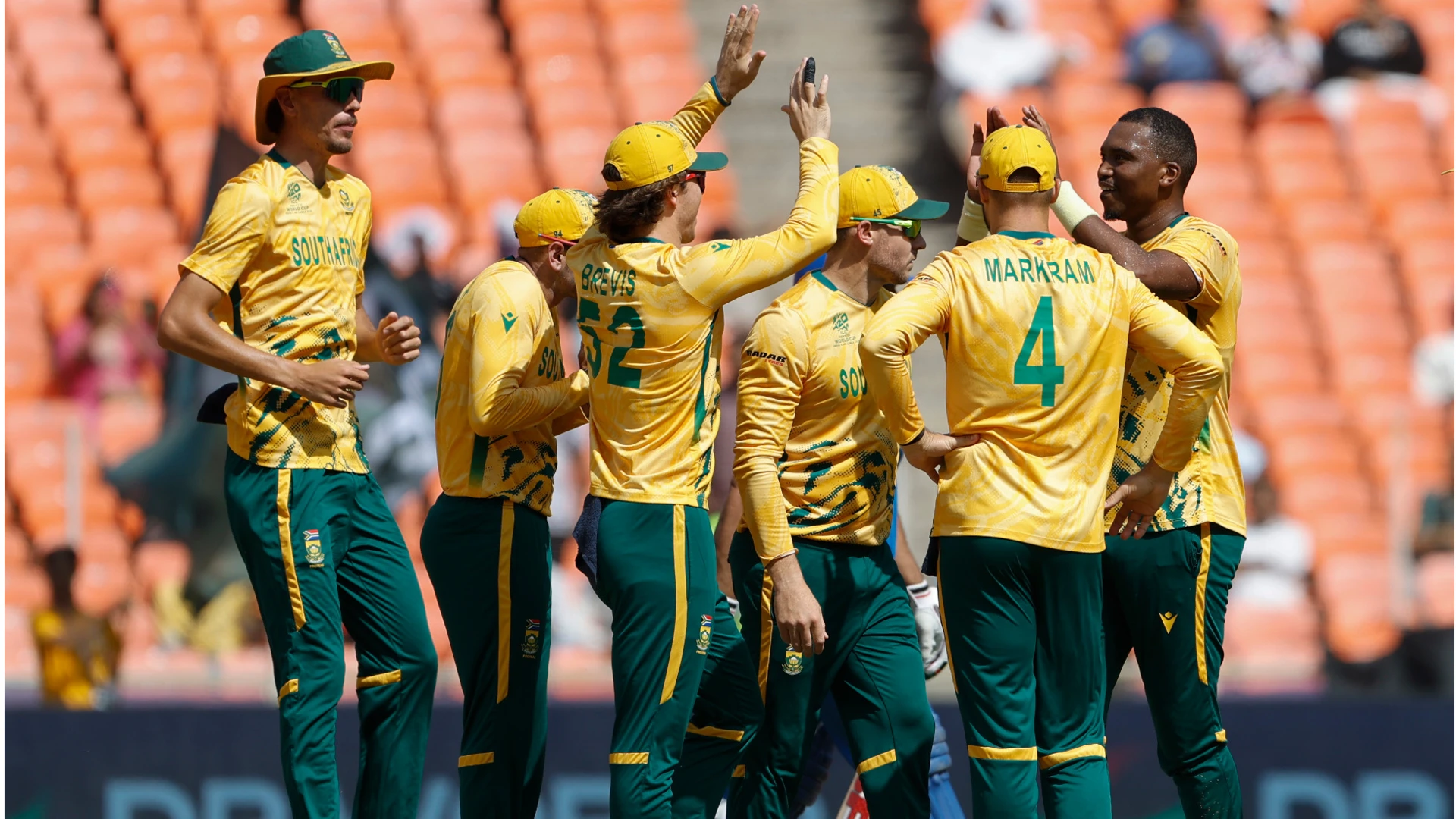
So I could be forgiven for spending Wednesday morning glued to a cricket transmission, and also for making the riveting World Cup T20 game between the Proteas and Afghanistan my lead in this week’s column.
Advertisement
As I said to a mate who was about to go into a customer meeting as the game in Ahmedabad headed towards the first of two Super Overs, I can turn this into work if I just give it a mention in my Striking It Rich column. That isn’t the only reason though.
It was also one of those rare white ball games that will be remembered by those of us who were lucky enough to watch it that will stick for a long time.
Way back in my youth there were limited overs games that stood out enough to linger in the memory. Old timers may remember the 1982 Datsun Shield final at a packed Wanderers between Western Province and Natal. It was a fractious game and went to the wire, with two incidents the players involved might regret now having instigated dominating the headlines.

The first was the Natal kingpin bowler and stalwart, the genial giant Vince van der Bijl, running Alan Lamb out at the non-strikers end as he stood outside his ground after Vince had fielded a ball played back to him. Vince was walking back to his mark and did what looked like a mock shy at the stumps.
Lamb didn’t move, and probably thought he was joking, so when Van der Bijl followed through by throwing the ball into the stumps and appealed, and Lamb was given out, the batsman and the WP team was rightly incensed.
In his excellent autobiography ghosted by John Bishop, ‘Cricket in the Shadows’, Van der Bijl, who was known for his sportsmanship and was generally liked by friend and foe, expressed his intense regret for what happened. In the book, Vince wrote a form of apology not only to Lamb, but to the game of cricket.
I can’t recall if Peter Kirsten, the WP captain that day, did the same in his book, co-authored by Telford Vice, ‘In the Nick of Time’, as by then the world had moved on and Kirsten had played for the Proteas, something that as the book title said came in the nick of time, and that was the main focus of his book.
But I imagine he probably will regret the tit-for-tat similar kind of run-out of the late Paddy Clift in an exceedingly tense finale to a low scoring game in which WP ended up prevailing by a couple of runs. Barry Richards, playing in one of his final seasons for Natal, was quoted in the Sunday media the next day, “If they wanted the money so badly they should have just asked me, I would have given it to them”.
Clearly that was a limited overs game (55 overs a side in those days) that mattered to the participants and mattered to the cricketing public for the controversy raged for days. And every Datsun or Nissan Shield Final, which was preceded by the Gillette Cup, was played in front of a Wanderers full house even though it was often, as was the case that day, two teams based outside of Johannesburg playing.
But subsequent to that era, when by the way limited overs games were still red ball games, most of what has now become known as white ball cricket has become an amorphous mass with just a few standouts, and most of those have been at World Cups. Let’s not linger too long Alan Donald’s run-out in the 1999 World Cup semifinal against Australia.
Or for that matter Shaun Pollock sitting with a funereal expression watching the rain fall after, as Proteas captain, he had got the DLS maths wrong in a crucial World Cup pool game in Durban. That was a home World Cup, of course the memory will linger. And so do the scars.
And back in 1992, the first World Cup that South Africa participated in, there was the nine wicket win over Australia in Sydney in the opening game that will forever be etched in my memory bank, as well as the emotion of the semifinal where the Proteas lost out to a rain adaptation that saw 23 runs needed in 12 balls turn into 22 runs needed off one.
🚨 MATCH RESULT 🚨
No script could have written this! Absolute cinema at the Narendra Modi Stadium! 🎬🔥
An extraordinary contest comes to a breathtaking close as #TheProteas seal victory in the most dramatic fashion! 🇿🇦
Two Super Overs were needed to decide this epic Group D… pic.twitter.com/cnxWIjBKqw — Proteas Men (@ProteasMenCSA) February 11, 2026
There has been the odd standout outside of a World Cup - the 438 game in 2006 of course, and AB de Villiers innings where he scored a century off just a few balls in a pink day game against West Indies where the platform had been laid by centuries from Rilee Rossouw and Hashim Amla.
But generally it is a World Cup where the memory sticks with white ball cricket, and usually a knock-out game. Wednesday’s game was not a knock-out, but it was a quasi knock-out in the sense that it was in the competition’s group of depth, with two sides advancing from the group to the Super Eights, and the other team being the in-form New Zealand, who SA play on Saturday.
I am glad I watched it, for it will join the list of white ball games that stick. And for me that is particularly rare if the format is T20.
IT WAS RABADA’S BLIP THAT ELEVATED IT
Although I enjoy going to BetwaySA20 matches because of the way it showcases this country’s young talent, and there are several players from all nations excelling at this World Cup coming off good form in the South African competition (think Sherfane Rutherford), they don’t tend to stick in the memory.
Not even Proteas games at World Cups. I watched almost every ball of every Proteas game in the last T20 World Cup, where they won several by the narrowest of margins and at least once defending ridiculously low totals.
However, apart from a Markram boundary catch in a last over thriller, I think it was against USA or Bangladesh, and the quality of the Indian bowling that decided the final, there isn’t a standout memory.
But Wednesday’s game will stick because of how it was decided - two Super Overs, and had the ball gone two metres either side of David Miller at the conclusion of the second, we could well have ended up going into a third as it would have been another tie.
It felt like one of those Wimbledon finals before the introduction of the tie-break last set decider that just went on and on, with the tension unbearable and seemingly never ending.
Not that for one moment I am suggesting there was the same gravitas around the events of Wednesday, but it was important for both teams. Afghanistan were effectively going to be knocked out if they lost, a Proteas loss would have left the 2024 beaten finalists needing to beat the Kiwis to get out of their group - and even then it would have come down to net run-rate.
Even before the Super Over decider the game was one that was more satisfying to me as a purist than many T20s are. For there was a lot of ebb and flow. When Ryan Rickelton and Quinton de Kock were together when SA batted first, it looked like the Proteas would make in excess of 200. But Afghanistan pegged them back and made it a contest.
When the Afghanistan openers were flying SA were in trouble. Then came three quick wickets and it was advantage Proteas, only for the Afghanistan middle order, seeking an historic win, to wrest the initiative back. Suddenly the Proteas looked beaten, only for them to fight back.
Going into the last over 13 were needed but the last pair were at the crease. Surely it was game over in favour of SA, and it was when Kagiso Rabada took the final wicket with the first ball. But, the celebrations were interrupted as the siren sounded.
It was a no-ball. KG bowled the free hit as a wide. So now it was 11 needed and still six deliveries remaining. Rabada was hit for six, there was another no ball, and suddenly all Afghanistan needed was two runs off three balls to complete the win.
Full marks to Rabada for being able to pick up an inaccurate throw and run out the last Afghanistan batsman as he attempted the winning run by what must have been not much more than a millimetre. It had been a game of fine margins, and continued as that in the first Super Over.
Had Rabada not got his hands on the ball as he dived for a boundary catch it would have been a six. Instead it rolled onto the ropes as a four. Those two runs made all the difference when Tristan Stubbs lined up the flat six that tied the scores off the first Super Over contest and sent it into a second Super Over.
Proteas fast bowling legend Dale Steyn summed it all up best in his role as commentator - “I don’t know if I should be angry with KG for that last over (in the regular game) or thank him because it was because of that over that this game was made special.”
Steyn was on the money with that comment. We might feel differently had SA not won. But they did, and they will now go deeper into the tournament having faced a severe pressure test and won a game decided by two Super Overs.
THE DRAMA JUSTIFIED IT
Allow me to admit that before the first Super Over I was questioning whether there should have been one at all. It was a league game after all. If there is a tie, surely the two teams should just share points, as if it was a draw. It is possible to argue too that it would have been fair, as Afghanistan really didn’t deserve to lose.
I have the same attitude to penalty shoot-outs in Cup games in soccer. It feels like a lottery to me and an unfair way to decide something with as much gravitas as, for instance, the Champions League or the FIFA World Cup. But the cricketing version of the penalty shoot-out is perhaps a fairer way of doing it and less of a lottery. You can only use three batsmen, but the entire team is on the field when it is your turn to field.
My only regret after Wednesday is that it got me thinking - it’s a huge pity, for South Africans at least, that there wasn’t a Super Over format decider to that World Cup ODI semifinal at Egbaston in 1999.
Then Alan Donald, who was run out when the scores were tied, would have had a chance to redeem himself by bowling the Super Over and maybe the Proteas would have advanced to their first ever World Cup final. Instead Australia advanced on the grounds they’d won the group match, which was also very closely fought.
ENGLAND CAN’T BE GLOBAL CONTENDERS IF THEY LOSE CALCUTTA CUP
So let’s get some rugby in here - we’re heading into the second round of the Six Nations, and already it looks like a two horse race - I make France the clear favourites, but England aren’t too far behind. They both produced statement performances in the opening round, but a win over Ireland at home must have more value than a win over Wales, even if Ireland aren’t quite the team they were.
England have been on an impressive winning run and have displaced Ireland as “the other northern team” that can challenge the Springboks for the World Cup title. They’ve clearly developed their game under the coaching of Steve Borthwick, as well as their depth, and it is hard to disagree with Rassie that something special is happening with England.
But as always, there’s a caveat - most of the England wins have been at home. Certainly their wins against big teams. And one venue they haven’t won at in quite a while is Murrayfield in Edinburgh.
On the basis of Scotland losing to Italy in Rome last week many will be making England strong favourites to retain the Calcutta Cup. But there are two things that would prompt me to urge you think twice before backing England - firstly, the appalling weather at the Stadio Olympico last weekend didn’t help Scotland’s running strengths, and it is predicted to be dry in Edinburgh, and secondly Scotland are always a different animal when they play against their hated rivals from south of the border.
There’s no denying that the Scottish forwards are going to have to improve their performance manifold from what they produced last week, but there is a storied history of Scottish packs doing just that, dating back to 1990 when John Allan, later to play for South Africa, was involved.
Last year England broke a sequence of defeats when they won 16-15 at Twickenham, but let’s not forget what happened in that game - Scotland actually scored three tries to one, but Finn Russell missed every kick. Russell is unlikely to do that again.
This is a litmus test for England. The other challengers for global supremacy like the Boks, All Blacks and France don’t lose in Edinburgh. At least not now they don’t (they did in the worst Bok years like 2002). England need to buck the trend of coming second in Edinburgh if they want to remain credible challengers.
THE WOODEN SPOON IS BECOMING A SIX NATIONS THING
If Scotland do lose to England, there’s a massive game coming up a week later - Wales against Scotland in Cardiff. It is a kind of quasi-final, because after Italy’s win in Rome last week, that may be the game that decides the wooden spoon. Actually lets give it more gravitas by capping it - Wooden Spoon. Because it’s becoming a thing given how Wales have hogged the last position in recent years.
And also because there are now two distinct divisions emerging in the Six Nations - the top half, and the bottom half. The top half is France, England and Ireland, although Ireland could find themselves relegated if they don’t wake up, and the bottom half are Scotland, Italy and Wales. The top half are teams with a realistic chance of winning the competition, the bottom half are teams that have no chance of winning it.
It’s unusual for me to say someone has no chance, for the beauty of sport is that weird things can happen, but right now there’s quite a bit of predictability about the Six Nations. And it may be the reason there seems to be a growing focus on who will avoid finishing last. The Wooden Spoon is becoming a thing, and if Wales were to avoid it this year it would be an achievement celebrated like they would if they won the World Cup.
Advertisement